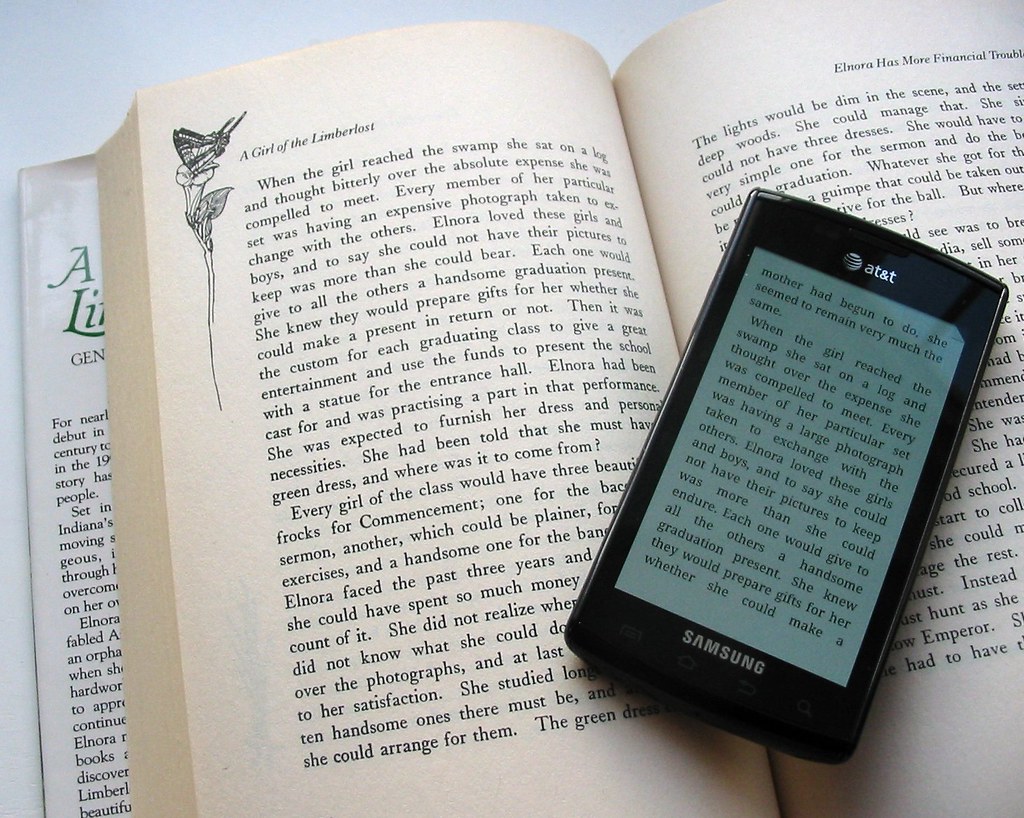
There are some issues that are acknowledged about reading online. People wonder if this should be considered real reading. Also, whether or not this is beneficial to children/students. In the article, a sentence states that "Traditionalists warn that digital reading is the intellectual equivalent of empty calories." ( Rich 12) This means that it is not good for you and doesn't help you in any way. I disagree, I believe that reading online can be just as good as reading a book. Also, the knowledge you acquire from a great book can be found online. The Internet has every genre, and everything imaginable to suit one's reading desires.
In contrast to the issues of online reading, there are many benefits as well. One benefit is the fact that the internet can please every ones reading preferences. It is easy to find online stories and typically doesn't take as long to read as a book. Also, in today's time, many children are more familiar with the computer. This helps because they may feel more comfortable reading from an online source rather than a book. Also, online reading takes place in the simplest of ways and it is better for children to do this rather than watch television. Online reading can also help readers develop skills such as locating information quickly/accurately, bringing together information, and interpreting pictures/videos. This is a way for struggling readers to practice and become stronger. For example, a boy named Hunter who struggled with dyslexia turned to online reading because he felt like the book had to many unnecessary details and he struggled with that. So, for some people digital literacy is an important form of learning.
While reading this article, one major point stuck out the most to me. In the case of the dyslexic boy named hunter, I was surprised to find out his test scores. On his traditional reading test, he scored below average in the lowest 10 percent. But, on the digital test he scored in the top quartile range. While most of the other students were the opposite and did poorly on his part of the exam. This shows that digital literacy is in fact more helpful for some people. For the students who struggle with traditional reading, there is still hope. They are able to read online and still obtain important information/skills.
Lastly, this piece relates to "Pencils to Pixels" in more than one way. First, both articles are about digital literacy in contrast to traditional. In "Pencils to Pixels" the author described how we came to computers from the very first form of writing. Included with that, the author makes sure to add in the details about how traditionalist were afraid to move on to the next invention in terror of it changing things for the worse. In this article, I find the same thing to be true. Educators/ School boards seemed to be concerned with whether or not digital literacy is actually helpful for children. They seemed to be geared more towards the negative connotation rather then the positives. They feel as if the traditional way of doing things is the best and gains the most information/knowledge, even if this is not actually true. Another similarity of the two articles is that both are comparing digital literacy to traditional literacy. In conclusion, digital literacy is a growing subject and traditionalist will have to adapt to the new age of literacy.

No comments:
Post a Comment